ByJohn A
A Guide to Crystal Shapes and What They Mean
Why Shape Is Worth Reading
Open any crystal listing and you’ll see a piece called a point, cluster, geode, sphere, or tower, with almost nothing said about what that word actually describes. The word has a physical side to it. It tells you how a mineral grew, or how somebody worked it after it came out of the ground. Running alongside that is a spiritual side, built out of the traditions people carry with them to the form.
Photos flatten all of that out. Put a polished natural point beside a cut tower in the same lighting and both come out of the frame looking equally glossy. If you want to compare forms in person, searching crystals shop near me can help you find places where you can inspect a base, crystal faces, and the finish before choosing, and a close look often tells you more than a product name does.
Natural Shape Versus Cut Shape
Mineralogists reach for the word “habit” when they mean a mineral’s outward growth form. Habit is a property geologists use to identify specimens, along with features such as color, luster, hardness, and cleavage or fracture. So it describes something you can examine on the material itself, not a display label.
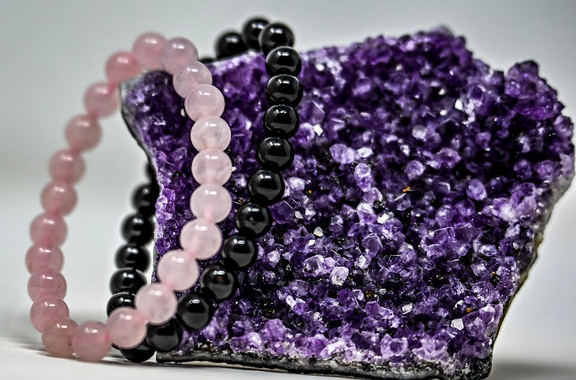
A natural point has growth faces that meet at a termination. A cluster consists of more than one crystal growing from a shared base, often called matrix, while a geode has crystals lining an interior cavity. A seller may have scrubbed the piece or taken a light polish to one surface, and those features will usually still be there to find.
Now consider the other category. A sphere, obelisk, palm stone, or pyramid has been shaped from rough material by a lapidary. The cutter may preserve interesting color, inclusions, or natural patterning, but the finished outline did not grow that way underground, and that distinction matters when you want the irregular history of a natural specimen rather than a deliberately balanced carved form.
Points and Terminations
A termination is the pointed end of a crystal, where natural growth faces meet. On quartz those faces can look sharp and geometric, though contact with surrounding rock, neighboring crystals, or the walls of a growth pocket may interrupt them. One end may be fully terminated while the other remains attached to matrix or shows a break.
“Terminated” is more than shop language. A gemological study of a naturally terminated quartz crystal documents a specimen examined by researchers and uses “fully terminated” to describe its natural growth form. So you’ve got a useful word now for reading a listing with more care.
Tradition links points with directing or focusing energy in spiritual practice. One person may set a point on a desk or altar as part of an intention-setting ritual; another just likes the way its faces pull the eye upward. The association belongs to tradition and personal practice, not a measured effect.
Clusters and Geodes
A cluster has many crystal points joined to one base, with faces often reaching in different directions. That matrix may be rough and uneven, which is part of how the piece formed rather than a flaw someone should have hidden. Turn a cluster over when you can, because the underside often shows how those crystals joined the base.
A geode is built around a cavity, with mineral growth lining the interior instead of forming one solid piece. Its shell, hollow center, and crystal-lined surface make it physically different from a loose point or a polished carving. Cut into two halves, a geode may sit neatly on a shelf while still showing that cavity-grown structure.
Among people who work with crystals, clusters are traditionally connected with shared or radiating energy. Protection, renewal, and inward reflection are the associations that come attached to geodes. Those ideas can shape a ritual or a room’s atmosphere for you, though they do not promise an outcome.
Choosing a Shape That Fits
Separate what’s in front of your eyes from what you want the piece to represent. A carved form can show careful cutting and polish, while a natural specimen may have uneven faces, attached matrix, or small marks from its formation. Neither one is automatically right for everyone.
- Natural points and clusters may show growth faces, matrix, or a termination. Crystal traditions often link points with focus and clusters with a shared atmosphere.
- Geodes invite you to inspect the shell, cavity, and interior lining. Traditional practice may connect their enclosed form with protection or quiet reflection.
- Towers and obelisks have cut sides and a shaped point. Some spiritual traditions use them in energy clearing or when setting an intention for a space.
- Spheres, palm stones, and pyramids are shaped for handling, display, or symbolism. Their meaning comes from tradition and personal practice rather than their underground growth.
Read the listing for plain descriptions of the form and finish. It should tell you whether you are viewing a natural formation, a natural piece with some polish, or rough material cut into a new shape.
What to Do Next
Begin with the form that keeps drawing your attention, then look past the shine. Check for a natural termination, a cluster base, an interior cavity, or the even surface of a carved piece. Those details tell you what kind of object you’re considering and why it looks the way it does.
If traditional meaning matters to you, treat it as part of your own intention rather than a promise attached to a stone. Set a natural point, a cluster, a geode, and a carved form next to each other first, and then choose the shape you want to bring home.